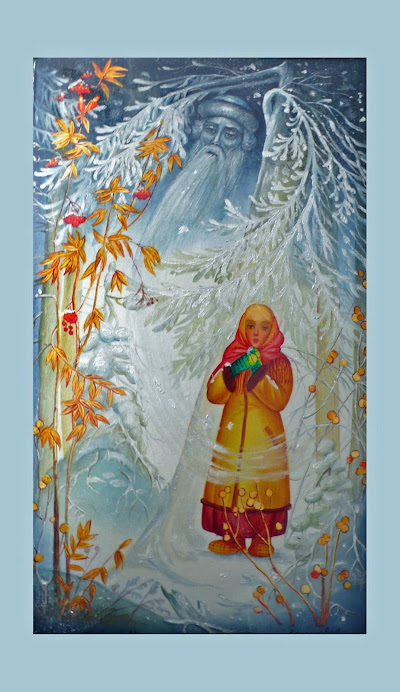

Grimm’s Children Legends No. 1
Saint Joseph in the Forest
There once was a mother who had three daughters. The oldest was naughty and mean. The middle child was much better, although she, too, had her shortcomings. But the youngest was a pious and godly child. The mother was so peculiar that it was precisely the oldest daughter that she loved most and she could not suffer the youngest one. That is why she often sent the poor girl into the big woods to be rid of her. She thought the girl would get lost and never more return. But like every good child, this girl had a guardian angel, who did not desert her. The angel always brought her back to the correct path. However, one day it seemed that her guardian angel was not guiding her by the hand for the child could not find its way out of the forest. The girl ran and ran until evening fell. Then she saw a light burning in the distance, ran toward it and came to a small hut. The child knocked and the door opened. Behind it, she found a second door, where she knocked again. An old man with a snow-white beard and venerable appearance opened the door. It was none other than the Blessed Saint Joseph. He spoke kindly to her “Come dear child, sit next to the fire on my little footstool and warm yourself. I’ll bring you a little clear water if you are thirsty. I don’t have anything for you to eat here in the woods except a few roots. You must first peel and cook them.”
Saint Joseph gave her the roots: the girl scraped them clean, then she took a piece of the pancake and bread her mother had given her and put everything in a little pot on the fire and cooked porridge. When it was finished Saint Joseph said “I am so hungry, give me a bit of your food.” The child was obliging and gave him more than she kept for herself. But God’s blessing was there and so the child’s hunger was satisfied. After they had eaten, Saint Joseph said “Let us go to bed: but I have only one bed. You lay down in it; I will lie on the straw on the ground.”
“No,” answered the child, “you stay in your bed; the straw is soft enough for me.”
Saint Joseph took the child in his arm and carried it to bed. The girl said her prayer and went to sleep. The next morning when she woke up, she wanted to say good morning to Saint Joseph but did not see him. She got out of bed and looked but could not find him in any corner. Finally she saw a sack with money behind the door. The sack was so heavy that the child could not carry it. On it was written that this was for the child who had slept there that night. The child took the sack and jumped away and returned happily to its mother. Because she gave her mother all the money, the woman had to be satisfied with the child.
The next day the second daughter also had an urge to go into the woods. The mother gave her a much larger piece of pancake and bread. The same thing happened to her. In the evening she came to the little hut of Saint Joseph, who gave the girl roots to make porridge. When the girl was finished the Saint said “I am so hungry; give me some of your food.” The child replied “Both of us can eat from the porridge.”
When afterward Saint Joseph offered his bed and wanted to lie down on the straw, the child replied “No, lay down on the bed, we both have enough room there.” Saint Joseph took the girl in his arm, laid her in bed and slept on the straw. In the morning the child awoke and looked for Saint Joseph. He was gone but behind the door the girl found a small sack with money. But the sack was only as large as the girl’s little hand. On it was written “For the child who slept here this night.” The child took the sack and ran home and gave it to its mother. But secretly the girl kept a few coins for herself.
Now the oldest daughter became curious and wanted to go into the woods the next morning. The mother gave her a pancake and as much bread and cheese as her heart desired. In the evening the girl found Saint Joseph in his little hut, just like the other two had found him. When the porridge was finished and Saint Joseph spoke “I am so hungry, give me some of your food!” the girl replied “Wait until I have eaten my fill.” Whatever I have left you can have.” But the girl ate almost everything and Saint Joseph had to scrape the bottom of the little bowl. The good man offered the girl his bed and wanted to lie on the straw. The child accepted this without hesitation, lay down in the little bed and left the hard straw for the old man. The next morning when the girl awoke, Saint Joseph could not be found. But the maid did not worry: she looked behind the door for the sack of money. She thought something was lying on the ground, but because she couldn’t really tell what it was, she bent over and hit her nose on the floor. Something stuck to her nose when she got up. To the girl’s horror it was a second nose sticking to her own. The girl began to scream and howl, but id didn’t help. She had to look at her nose and see how it protruded so very far from her face. She ran away screaming until she found Saint Joseph. She fell down at his feet and prostrated herself. Finally, in his mercy, he took away the nose and what’s more, gave her two Pfennigs. When the girl returned her mother stood in front of the door and asked “What presents have you received?”
The girl lied and said “A big sack full of money, but I lost it on the way home!”
“Lost it!” the mother cried. “We sure want to find it again.” And she took the girl by the hand and wanted to go out searching. First the girl started to cry and did not want to go. But finally she went along. On the way, the two were overcome by so many snakes and lizards, that they could not save themselves. They stung the child until she was dead, but the mother they stung in her foot because she had not raised the girl better.
Read more Christmas fairy tales by clicking on the links:
http://christmasfairytales.blogspot.com/2009/12/christmas-fairy-tale-trolls-of-winter.html
Find many more fairy tales at:
FairyTaleChannel.com